
 Upgrade plan
 Cancel plan
 Settings
 Change Password
 Contact Us
[TX] Which transfer on death deed election keeps a spouse’s share from passing to stepchildren?
 25
25
 11
11



Full conversation
Are you familiar with Texas law?


I understand that navigating legal matters can be challenging. Can you please specify what area of Texas law you need assistance with?
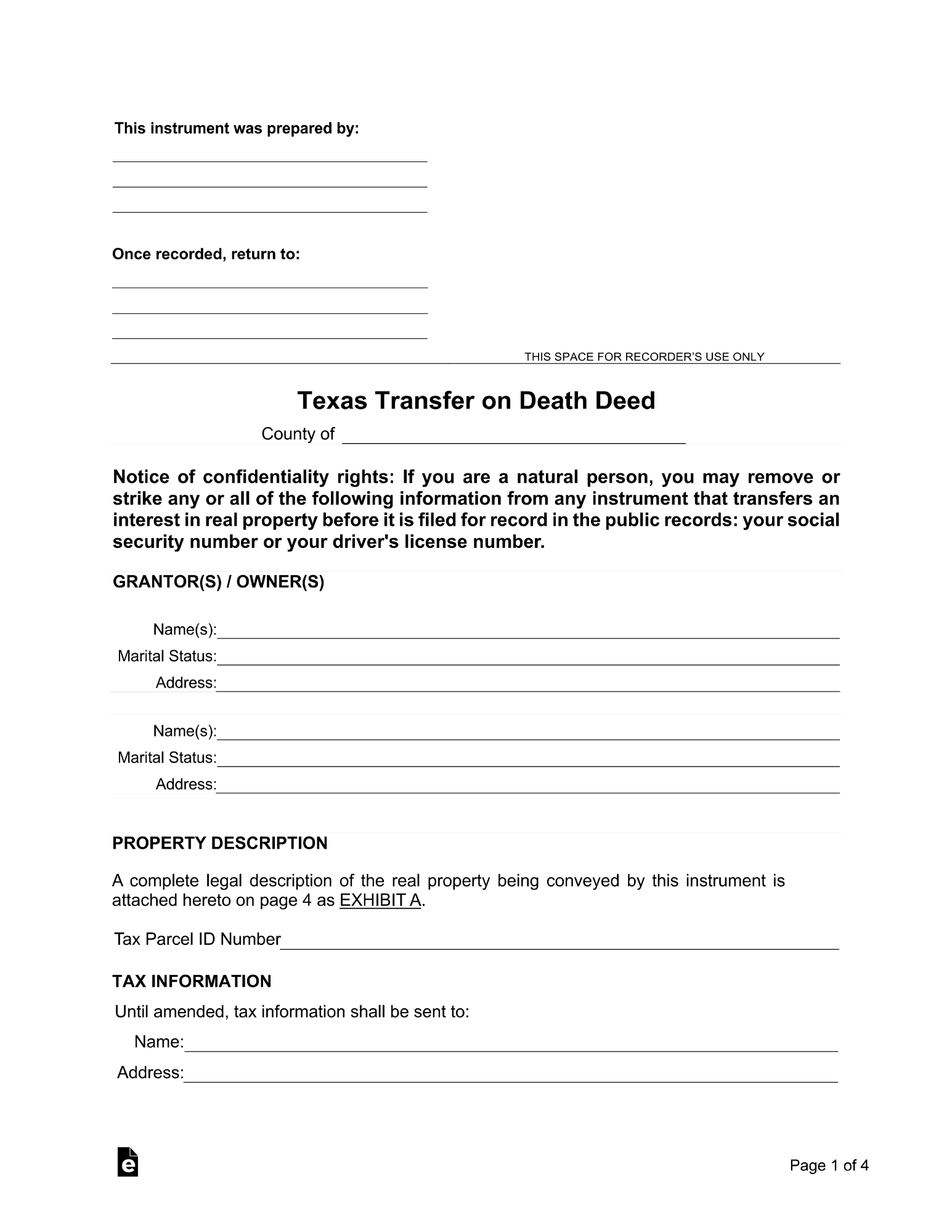
Need help to review Texas Revocable Transfer on Death Deed.
Have you already taken any steps regarding your legal issue, such as filing a complaint or seeking advice from another attorney?
No, I need help to review this document.

Hello, and thank you for reaching out! I'm Jon, a licensed attorney with over 13 years of experience, here to help. I understand legal matters can feel overwhelming, but you're in good hands. My goal is to explain things clearly and guide you toward the best possible solution for your situation. Just a quick note: our conversation is for general legal information only and does not create an attorney-client relationship.
Are there any particular concerns or questions you have about the deed, such as its validity, how it affects your property, or potential tax implications?
I have a question on the document verbiage itself.
Could you please share the specific language of the Texas Revocable Transfer on Death Deed you'd like reviewed?
Are you familiar with Texas law?
I am, but would need the specific language.
If at least one primary beneficiary survives us, select option A or B. Anti-lapse election or Surviving Primary Beneficiaries election.
Understood! I believe I have all the information I need. Is there anything else you'd like to add before I start working on your answer? If not, I'll get started right away.
What we are doing is, as a married couple with joint ownership of our home, we want to record a transfer on death deed to each other in the event one of us passes, so the ownership share of the deceased goes directly to the other.
Got it! I just need a few minutes to put together a complete response for you. It shouldn't take longer than about 4 to 5 minutes, and I want to make sure it's clear and comprehensive. Thanks so much for waiting, I really appreciate your patience.
We have a blended family. I want my 50% ownership of the house to transfer to my spouse, not to my children.
Ok.
In Texas, a Transfer on Death Deed can be a very effective way to handle this kind of transfer, but the decision between the anti-lapse option and the surviving beneficiary option is where things can quietly go wrong if you're not careful.
Since your goal is for your 50% interest to go only to your spouse, the biggest question is what happens if they die first. With the anti-lapse option, your spouse's share would not simply disappear. Instead, it would pass to their legal heirs, which could include children from a prior relationship. For someone trying to tightly control where the property ultimately ends up, that outcome is usually the opposite of what they intended.
The surviving primary beneficiary option works differently. If your spouse dies before you, the Transfer on Death Deed essentially fails because there is no surviving beneficiary. Your share stays in your estate, and nothing automatically shifts to your spouse's heirs. For many married couples, this is the cleaner and safer choice because it prevents your interest from being unintentionally pulled into the other side of the family.
It's also important to confirm how the property is currently titled. In Texas, most married couples own property as community property. If your deed already states "joint tenants with right of survivorship," the home would automatically pass to the surviving spouse at death, making a Transfer on Death Deed unnecessary or even confusing.
If there is no right of survivorship language, a transfer on death deed can be a good way to ensure your 50% interest transfers as you intend. One benefit of a transfer on death deed is that it is revocable at any time during your life. Texas Estates Code, Chapter 114, the Texas Real Property Transfer on Death Act, governs revocation. (TX Est Code § 114.052) If your situation changes, you can undo it. However, Texas law requires the deed to be recorded in the county clerk's office while you are alive for it to be valid; recording before death is a statutory requirement under Chapter 114 of the Texas Estates Code. If it isn't recorded, it won't have any legal effect.
It's also worth thinking about the bigger picture. Once your 50% transfers to your spouse, they would own 100% of the home and could legally leave the entire property to their own children. If you want your children to eventually receive a share after both of you pass, a Transfer on Death Deed alone may not be enough, and a life estate or living trust may better match that long-term goal.
Based on what you've described, selecting the surviving primary beneficiary option best aligns with your intent. It keeps the transfer strictly between you and your spouse and avoids unintended consequences if they pass before you, as long as the deed is properly recorded in the county deed records. (This general framework tracks the structure of the Texas Real Property Transfer on Death Act, codified at Texas Estates Code Chapter 114, which governs execution, revocation, and recording of transfer on death deeds in Texas.)
Ok, I got this. But how would I answer then the two questions I outlined before?
Since you want your ownership to transfer strictly to your spouse and not to your children, you should select Option B, the Surviving Primary Beneficiaries election. This choice ensures that the transfer only occurs if your spouse is actually alive to receive it. If your spouse were to pass away before you, Option B prevents your interest from accidentally passing to your spouse's heirs or children through the anti-lapse laws. When the form asks for the designation of beneficiaries, you will list your spouse's name as the primary beneficiary. To address your concern about the "50% ownership," you don't actually need to specify "50%" in the beneficiary section. In Texas, a TODD transfers whatever interest you own at the time of your death.
So Texas deeds are notorious for showing joint without right of survivorship, hence this document. So you're saying I need to select what? Am I not the surviving beneficiary?
Since Texas deeds often lack the right of survivorship, you should select Option B, the Surviving Primary Beneficiaries election. This choice ensures your interest transfers to your spouse only if they survive you, preventing your share from accidentally passing to other heirs or children through anti-lapse laws. By each recording a deed naming the other under Option B, you effectively create the survivorship link you currently lack while keeping the property strictly between the two of you.
What if we both file the document for each other? It only goes into effect when one of us dies?
Exactly. Each spouse filing their own deed naming the other is the standard approach for Texas couples. Both documents remain inactive during your lives, allowing you to retain full control and ownership. When one spouse passes, their deed triggers and automatically transfers that 50% interest to the surviving spouse without probate. By selecting Option B, the surviving spouse's own deed to the deceased partner simultaneously lapses and becomes void, ensuring the survivor owns 100% and the interest is not diverted to other heirs. But I do hope the information I provided was helpful and addressed your question. If there's anything else you need, please don't hesitate to reach out. I'm always happy to assist. Wishing you a fantastic day ahead!
Ok, you've answered! Thanks so much!
You're so welcome! I'm thrilled I could help, don't hesitate to reach out if you need anything at all!
Disclaimer
By messaging FreeLegalAdvice.com, you agree to our Terms and have read our Privacy Policy.
The information provided on AskaLawyer.com is for general informational purposes only and does not constitute legal advice. While we strive to ensure the accuracy and timeliness of the information presented, we make no guarantees regarding its completeness or applicability to your specific circumstances.
Use of this website does not create an attorney-client relationship between you and FreeLegalAdvice.com or any of its attorneys. Communications through this website, including any responses from attorneys, are not privileged or confidential. For advice tailored to your individual situation, we recommend consulting a licensed attorney in your jurisdiction.
FreeLegalAdvice.com disclaims any liability for actions taken or not taken based on the content of this site. We are not responsible for any third-party content that may be accessed through this website. Reliance on any information provided herein is solely at your own risk.


